
Most jerky recipes start with slicing a whole cut of meat, but ground meat jerky is a legitimate, widely-used alternative — and turkey is one of the best proteins for it given how lean ground turkey typically is. The process is different enough from whole-muscle jerky that it deserves its own explanation.
Why Make Jerky from Ground Turkey?
Three practical reasons people choose ground over whole-muscle turkey jerky: it’s usually cheaper (ground turkey costs less per pound than whole breast in many markets), it’s more consistent (no slicing skill or partial-freeze step required, see our whole-muscle turkey jerky guide for that method), and it produces a more tender, uniform bite that some people prefer over the fibrous chew of sliced jerky.
Equipment: The Jerky Gun
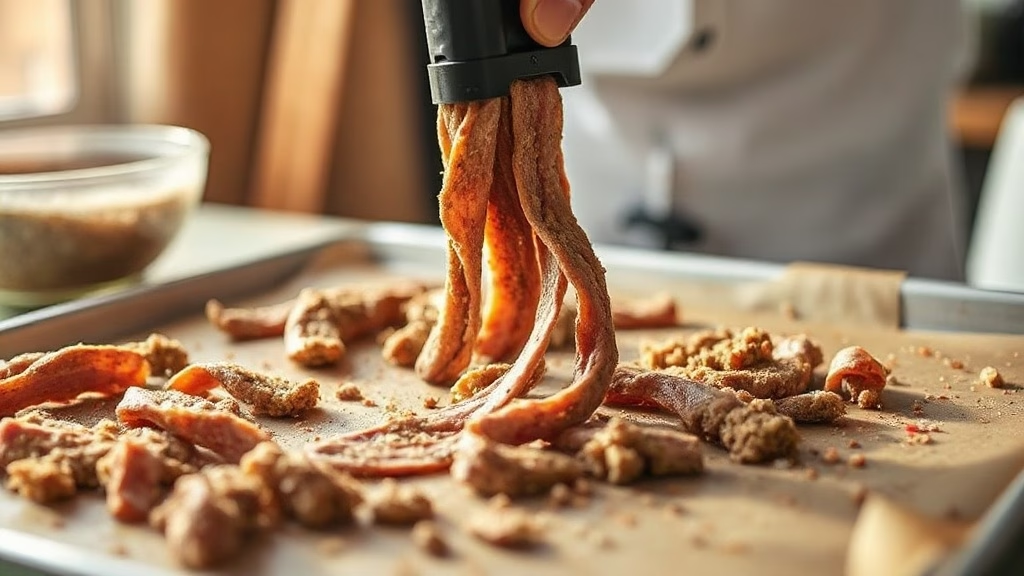
Ground meat jerky requires a jerky gun (sometimes called a jerky cannon) — a caulk-gun-style tool that extrudes seasoned ground meat into flat strips directly onto your dehydrator trays. Most models come with interchangeable nozzles for different strip widths and shapes (flat strips, rounds for jerky sticks). This is the one piece of equipment whole-muscle jerky doesn’t require.
Step 1: Season Before Mixing, Not After
Unlike whole-muscle jerky, where marinade soaks into pre-cut strips, ground meat jerky is seasoned by mixing the cure and spices directly into the raw ground turkey before extrusion. This means the seasoning distributes far more evenly than a marinade ever could, but it also means you need a binder to hold the extruded strips together:
- 1 lb ground turkey (93% lean or leaner recommended)
- 1 tsp curing salt (Prague Powder #1) — important for ground meat jerky specifically, since the meat’s larger surface area and lower density make it more susceptible to bacterial growth during the long, low-temperature drying process than whole-muscle strips
- 2 tbsp soy sauce
- 1 tsp garlic powder, 1 tsp onion powder, 1/2 tsp black pepper
- 1 tbsp brown sugar (optional)
Mix thoroughly by hand for 2–3 minutes — this develops the meat’s natural proteins enough to bind the strips together during drying, similar to how kneading develops gluten in bread dough. Under-mixed ground jerky falls apart on the dehydrator trays.
Step 2: Extrude onto Trays
Load the seasoned mixture into the jerky gun and extrude directly onto dehydrator trays lined with a light coating of non-stick spray, or onto the mesh screens some jerky guns include specifically for this purpose. Keep strips a consistent thickness (roughly 1/8–3/16 inch) for even drying, and leave space between strips for airflow.
Step 3: Reach 165°F, then dry at 140°F
Ground turkey needs the same safe internal temperature as any poultry: 165°F (USDA FSIS). A dehydrator rarely gets meat that hot by itself, so either heat the extruded strips before drying or give the dried strips 10 minutes in an oven preheated to 275°F (NCHFP), and confirm with a probe thermometer. Dry at a steady 140°F and start checking after 3 hours; uniform extruded strips tend to dry evenly. Our jerky calculator lays out the full process and expected yield for a batch.
Curing Salt: Why It Matters More Here
This is the most important safety difference from whole-muscle jerky. Ground meat has significantly more surface area exposed to potential bacterial contamination during processing than a whole strip of muscle, and the grinding process itself can introduce bacteria from the surface into the interior of the meat. Curing salt (sodium nitrite, sold as Prague Powder #1 or Instacure #1) inhibits bacterial growth, particularly botulism risk, during the extended low-temperature drying process. Don’t skip this step for ground meat jerky even if you sometimes skip it for whole-muscle strips.
Texture: What to Expect
Ground turkey jerky has a more uniform, less fibrous bite than sliced jerky — some people describe it as closer to a jerky-textured meat stick than traditional chewy jerky. If you specifically like the stringy, pull-apart texture of whole-muscle jerky, ground jerky won’t replicate that. If you find whole-muscle jerky’s texture tough on your teeth, ground jerky is often easier to eat.
See our tested dehydrator picks — any of them work fine for ground meat jerky as long as your jerky gun’s extruded strips fit the tray dimensions.